
Pricing is a crucial factor when companies choose between staffing agencies. Some businesses select providers based primarily on lower costs, even when quality, reliability, or technlogy are not comparable. Understanding how agencies structure their pricing can help companies make more informed staffing decisions.
Key Takeaways for Businesses
This table summarizes the most common costs and shows the range clients can expect depending on worker classification, industry, and agency practices.
Staffing agencies use different pricing models depending on the role, project type, and client needs. Understanding each model helps you budget effectively and choose the right provider.
Agencies often charge a percentage of a new hire’s first-year salary when placing permanent employees, typically 15%–30%. This fee covers recruiting, candidate screening, and sometimes onboarding support.
Pros: Predictable cost; agency handles recruiting end-to-end
Cons: Upfront fees; cost can be high if turnover occurs
For temporary staffing, agencies usually charge a markup on the worker’s hourly pay. Typical markups range from 25%–50% for W2 employees and 13%–40% for 1099 contractors, depending on role complexity and industry.
Pros: Flexible, scalable workforce; pay only for hours worked
Cons: Less control over process; markups can vary widely
For project-specific staffing or embedded teams, agencies may charge a predefined monthly or project fee based on hours and resources needed to complete the work. Common in IT, creative, or consulting projects.
Pros: Predictable project cost; aligned with deliverables
Cons: Harder to adjust for short-term changes; may be less suitable for small tasks
Some agencies, especially for executive or niche roles, require an upfront retainer plus ongoing payments. This guarantees dedicated recruiting effort and in-depth candidate sourcing and assessment.
Pros: Dedicated service for hard-to-fill positions; higher quality candidates
Cons: Higher upfront cost; not suitable for short-term or high-volume hiring
Certain agencies offer a flat fee per day or per shift, simplifying budgeting for high-volume or repeat temporary staffing.
Pros: Easy budgeting; predictable cost per worker
Cons: May be more expensive for longer-term assignments or specialized roles
Agencies may charge a fee when converting a temporary worker to permanent. Fees can be a percentage of salary, tied to hours worked, or a flat placement fee.
Pros: Flexible for temp-to-perm conversions
Cons: Policies vary; upfront fees may apply
Pricing depends on the role and the experience required. Higher-quality workers or those with specialized skills command higher rates.
Warehouse workers typically earn between $15 and $30 per hour. Client billing rates are usually higher than worker pay, reflecting agency markups, ranging roughly from $22 to $65 per hour. Agencies focused on flexibility, reliability, and quality may charge at the higher end, while others may offer slightly lower pay.
Hourly rates vary widely based on role, location, and urgency. Event workers typically earn $18–$42 per hour, with specialized or high-demand roles sometimes reaching $50 per hour. Clients generally pay $23–$65 per hour, though many aim for $30–$37.50 per hour for typical 4–5 hour events.
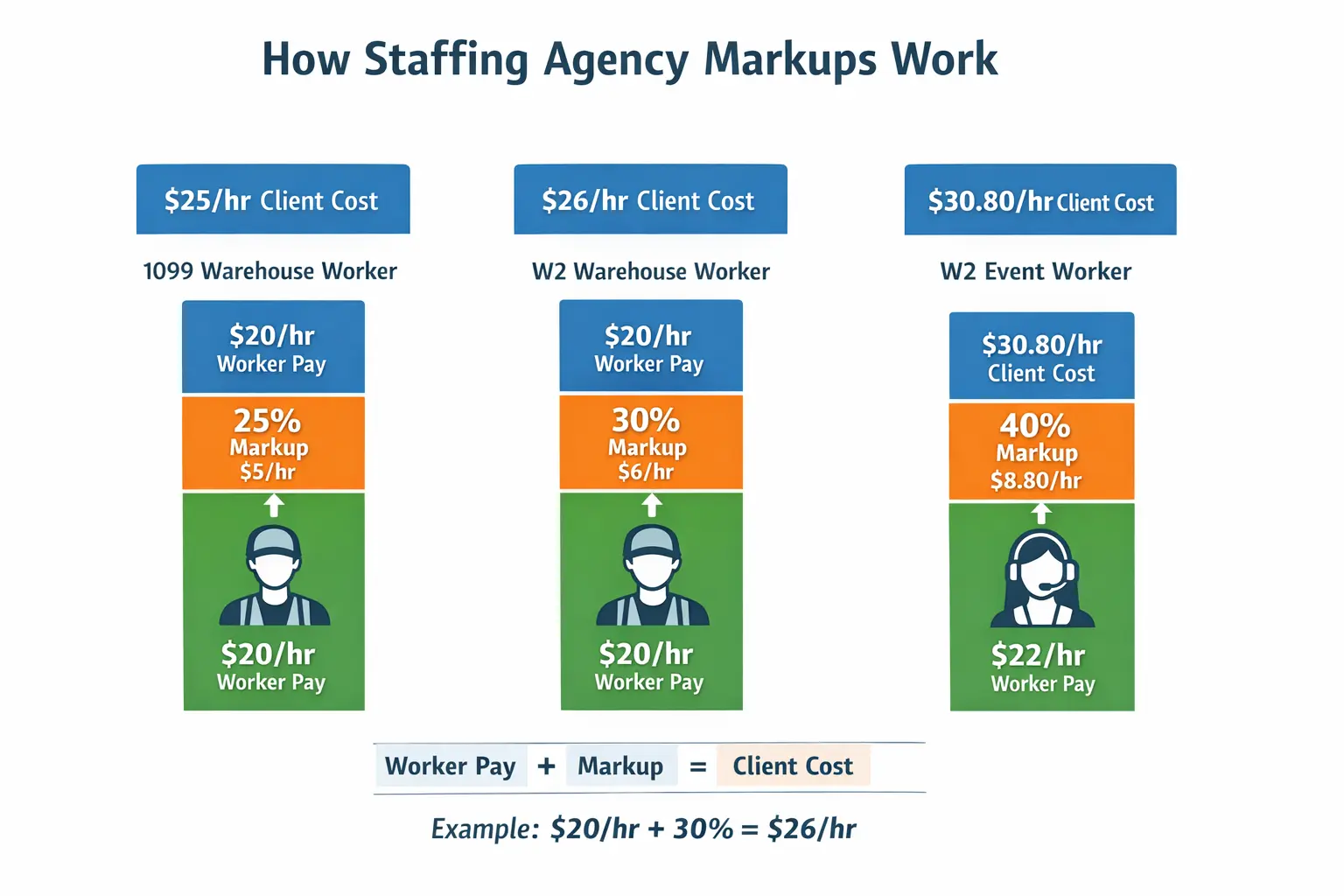
Staffing agency markups are the additional percentage or amount charged above the worker’s base pay. For example, a worker earning $20/hour with a 25% markup would cost the client $25/hour.
Example: A warehouse worker earning $20/hour with a 25% markup costs the client $20 × 1.25 = $25/hour.
Staffing agency markup rates can vary widely: 1099 workers might see markups from 13%–40%, while W2 workers range roughly 25%–60%. In warehouse staffing, W2 markups over 40% are rare; in hospitality, markups can be higher.
Volume of business, client agreements, location, and service complexity can all influence markup rates. Some agencies offer tiered pricing, flex rates, or credit-based systems where clients prepay for hours or shifts.
Agencies may provide tiered rebates, minimum spend guarantees, or annual incentives to adjust markup based on client usage.
Some agencies offer flat daily fees per worker—for example, around $45/day—which can simplify budgeting for clients.
Direct hire fees apply when a client wants to convert a temporary worker to a permanent employee. Policies vary by agency: fees may be tied to worker longevity, waived after a certain number of hours worked (typically 120–450 hours), or charged upfront. Some agencies use fee waivers strategically to negotiate business.
Worker classification affects overall pricing. For 1099 workers, agencies pay only the contractor, with minimal administrative costs and occasional occupational accident insurance. W2 workers involve higher costs due to payroll taxes, workers’ compensation, benefits, and insurance, which can increase overall agency expenses by roughly 10% or more compared to 1099 placements.
Some agencies charge booking or usage fees on top of markup. Background checks, drug tests, and compliance checks are often billed separately. Fees for onsite management apply if clients request supervisors or leadership, and travel or transportation costs may be added, though platforms like Instawork often source nearby workers to avoid these extra charges.
Staffing agency costs and internal hiring costs differ mainly in how expenses are structured.
Staffing agencies typically charge a placement fee of about 15% to 25% of a new hire’s first-year salary for permanent roles or apply an hourly markup of roughly 25% to 50% for temporary workers. This fee usually includes recruiting, candidate screening, payroll processing, taxes, workers’ compensation, and compliance.
In contrast, internal hiring also carries hidden costs, including the time hiring managers spend manually reviewing candidates (though leveraging an AI-powered ATS like Manatal) can significantly reduce this screening time), as well as business impacts from longer time-to-fill such as lost productivity, overtime for current employees, and missed revenue opportunities.
Price is often the first factor businesses consider when selecting a staffing agency, especially for temporary labor. Some agencies charge less because they provide fewer services, use less experienced recruiters, or take on higher-risk placements with minimal vetting. While lower fees can save money upfront, they may come with trade-offs such as slower response times, less reliable workers, or limited support for compliance and payroll.
Agencies compete on their ability to fill shifts consistently with high-quality workers. Many businesses eventually realize that paying more for reliability, thorough screening, and guaranteed shift coverage can deliver greater long-term value. Evaluating agencies on metrics like fill rates, worker retention, and client reviews helps determine if higher costs are justified.
Companies often balance multiple staffing providers to meet their needs for price, quality, and availability. Transparent billing, clear markup structures, and consistent performance tracking make it easier to compare agencies and choose the right combination of cost and dependability.
Billing practices differ: some agencies invoice weekly, others monthly. Clients increasingly seek transparency, wanting to understand how much of the total bill goes directly to workers versus the agency’s markup or additional fees.
Staffing agencies typically charge employers an hourly bill rate that includes the worker’s pay plus a markup.
Most markups range:
Staffing agencies do not charge job seekers fees for finding employment. Instead, they are paid by companies looking to hire, making their services, including resume help and job placement, completely free to candidates.
The total cost depends on role type, urgency, and service complexity, but most businesses pay:
The final price usually includes payroll taxes, workers’ compensation, recruiting, scheduling, and replacement coverage. Some agencies bundle these into a single markup, while others charge additional fees.
Direct hire fees are usually calculated as a percentage of the employee’s annual salary or tied to hours worked before conversion.
Typical structures include:
Policies vary widely by agency, but fees generally decrease the longer the worker stays on assignment before hire.
Payrolling (employer-of-record services) is usually priced as a percentage added to the worker’s wages to cover payroll taxes, insurance, and administration.
Typical payrolling fees:
This option is often cheaper than full recruiting because the client sources the worker.
Temp agency hourly costs equal worker pay + markup.
Typical example:
Higher rates apply for specialized skills, last-minute shifts, or high-risk roles. Lower rates usually apply for high-volume or long-term assignments.
Staffing agencies charge employers an hourly rate that includes the worker’s pay plus a markup, which covers administrative costs, payroll taxes, insurance, and agency profit. Markups typically range from 13%–40% for 1099 contractors and 25%–60% for W2 employees, depending on role, industry, and service complexity. Additional fees may apply for background checks, onsite supervision, or travel, though some agencies bundle these into the markup. Flat daily rates or direct-hire conversion fees may also be offered, making total costs flexible based on the assignment and worker classification.
Local temporary agencies typically charge part-time staff by combining the worker’s pay with a markup, which covers administrative costs, payroll taxes, insurance, and agency profit. Markups for part-time or temporary roles usually range from about 13%–40% for 1099 contractors and 25%–60% for W2 employees, depending on the agency, worker type, and industry. Some agencies may charge additional fees for background checks, drug testing, onsite supervision, or travel, while others bundle these into the markup. Rates can vary by role, urgency, location, and service complexity, and some agencies offer flat daily rates or direct-hire conversion fees, giving businesses flexibility to manage costs when hiring part-time staff.