
Training temporary workers can be challenging for many companies. Temporary staff rotate frequently, which means businesses often need to train new workers repeatedly. Because temps are usually hired for short assignments, they also need to become productive very quickly. While staffing agencies typically handle administrative onboarding, the client company must handle role-specific training, safety procedures, and workplace processes.
Without a structured approach, this can lead to confusion, safety risks, and slower productivity.
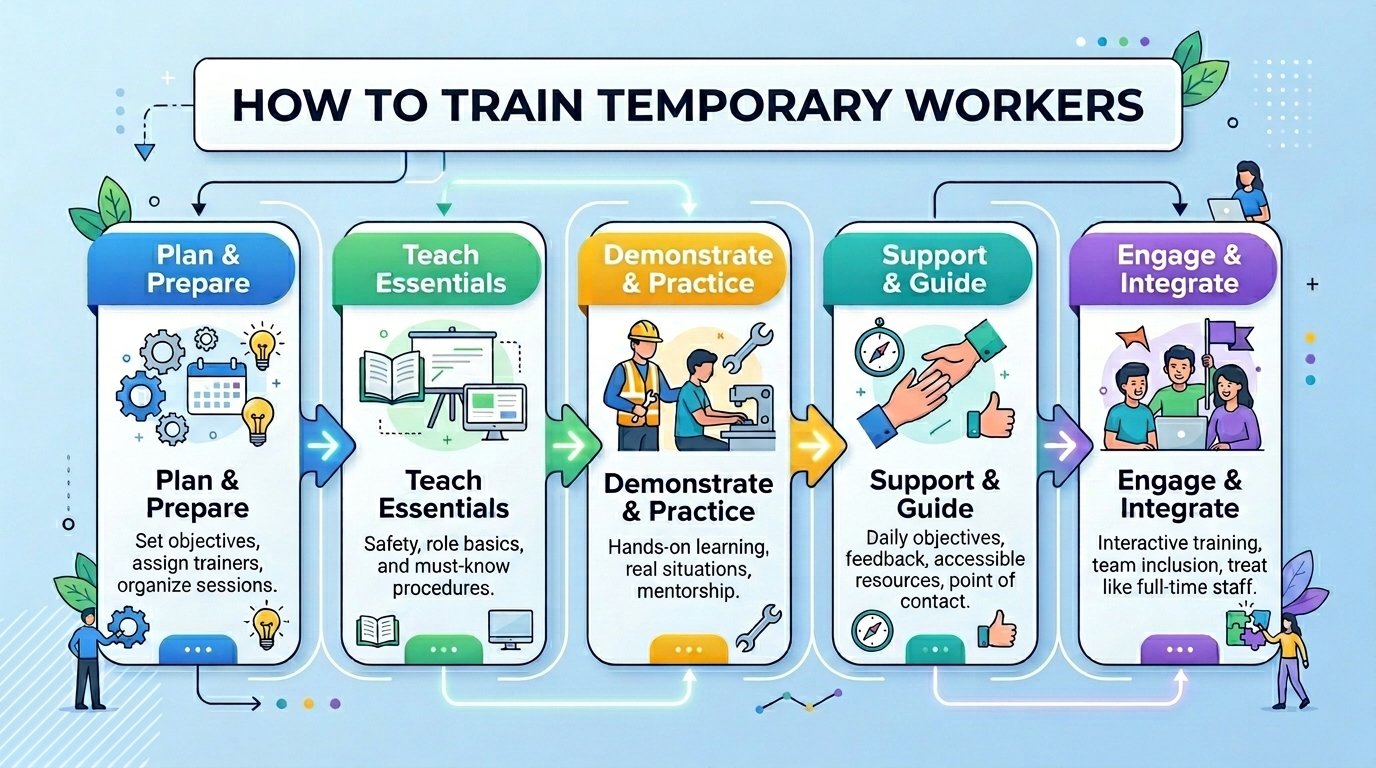
The good news is that training temporary workers does not need to be complicated. With a clear plan, designated trainers, practical demonstrations, and accessible resources, companies can onboard temporary staff quickly and effectively by focusing on essential skills and short, structured training sessions.
This guide explains practical methods you can use to train temporary workers efficiently while helping them become productive as quickly as possible.
Start by mapping the skills temporary employees will need and the tasks they will perform. Identify the essential steps required for the role and design training around those skills.
Planning the training in advance helps reduce confusion and ensures that workers learn the most important parts of the job first.
Assign a specific person responsible for onboarding temporary workers. In many workplaces, this can be an onboarding coordinator or a lead employee.
This person may handle tasks such as:
Having a dedicated trainer helps ensure that every temporary worker receives consistent and organized training.
When onboarding multiple workers, start with a group session covering general topics such as workplace rules, expectations, and company policies.
After the general orientation, divide workers into smaller groups based on their specific roles so they can receive targeted instructions relevant to their tasks.
This approach saves time while still providing role-specific training.
Safety training should always be one of the first steps in onboarding temporary workers, especially in environments such as warehouses, factories, and manufacturing facilities.
Workers should learn:
Because temporary workers often move between workplaces, they must understand the safety procedures specific to your location.
Proper safety training reduces accidents and liability.
Temporary workers perform best when they know exactly what is expected from them each day.
Provide clear instructions about:
Simple and specific objectives help workers stay focused and productive.
Temporary workers have limited time to learn the job, so training should be structured into short, focused modules.
Keep training sessions under half a day whenever possible. Short sessions help workers absorb information faster and reach proficiency more quickly.
Typical orientation sessions may include:
Even short-term workers benefit from structured onboarding.
Before training begins, assess the worker’s experience and certifications.
For example, if a worker already has a forklift certification, you may only need to explain site-specific rules rather than basic operation.
Tailoring training avoids wasting time and allows you to focus on the information that matters most.
When training temporary workers, focus on:
Avoid overwhelming them with unnecessary background information. Prioritize practical instructions that allow workers to perform their tasks correctly and efficiently.
Workers learn faster when they see the job performed in real situations.
Combine classroom explanations with hands-on demonstrations. Temporary workers should be able to apply instructions immediately after seeing them demonstrated.
This approach combines:
Practical experience helps workers retain information and develop skills more quickly.
Assign new temporary workers to experienced employees who can guide them through their tasks.
Choose employees who are comfortable explaining processes and who create a supportive environment for new workers.
This mentoring approach benefits both sides:
Encourage mentors to support rather than supervise in a controlling way.
Temporary workers need frequent feedback to improve quickly.
Offer constructive guidance and recognize progress throughout the day. Even small acknowledgments can help workers feel confident and motivated.
Positive reinforcement also helps workers understand that their contributions matter.
Temporary workers should always know who they can approach with questions or concerns.
Having an on-site coordinator or supervisor helps workers:
A clear point of contact reduces confusion and helps workers feel supported.
Training materials should be available in multiple formats so workers can access them easily.
Useful formats include:
You can also:
Providing internet access at the workplace also ensures that workers can access training materials quickly.
Allow workers to comment on shared documents so questions and insights can benefit everyone.
Training can be stressful for temporary workers because they must adapt quickly to new environments and teams.
Make training more engaging by using:
An engaging training environment helps workers feel comfortable and improves knowledge retention.
Most employees take months to feel integrated into a team, but temporary workers may change teams frequently.
Making them feel welcome and valued helps them adapt faster and perform better.
Simple actions such as introductions, encouragement, and inclusion in team interactions can significantly improve their experience.
Temporary workers should receive the same operational training and orientation as full-time employees.
The main difference is that benefit-related onboarding is typically excluded.
Using the same training framework ensures that temporary staff understand:
Treating temporary workers like regular employees also promotes professionalism and consistency.
Training temporary workers is typically a shared responsibility.
Staffing agencies usually handle:
Employers are responsible for:
This shared model allows agencies to manage compliance while employers focus on practical job training.
Training temporary workers effectively requires a structured and practical approach. Companies should focus on essential skills, deliver training in short sessions, assign dedicated trainers, and prioritize safety from the beginning.
Employers are responsible for job-specific training and workplace orientation, while staffing agencies usually manage administrative onboarding and compliance. When both sides coordinate effectively, temporary workers can become productive much faster.
Most importantly, temporary workers should be treated like full-time employees during onboarding. Clear instructions, hands-on training, accessible resources, and supportive supervisors help them adapt quickly and perform their jobs successfully.
Yes. Even though staffing agencies may provide compliance training and paperwork, employers must train temporary workers on job-specific tasks, safety procedures, equipment use, and workplace expectations.
Training responsibilities are usually shared. Staffing agencies handle administrative onboarding and compliance training, while employers provide role-specific training, safety instruction, and workplace orientation.
Training should be short and focused. Many companies divide onboarding into short sessions, often less than half a day, and prioritize the most important skills needed for the job.
The fastest approach combines demonstrations, hands-on practice, and mentorship. Pairing new workers with experienced employees and providing clear instructions allows temporary workers to learn quickly and become productive sooner.
If you'd like, I can also optimize this article for SEO (improve headings, add keywords like temporary worker onboarding, temp worker training checklist, etc.) so it performs better in search results.