
Staffing agencies connect job seekers with employers, acting as intermediaries to fill temporary, contract-to-hire, or permanent positions. They handle sourcing, screening, and interviewing, allowing companies to quickly fill vacancies while offering job seekers opportunities to gain experience or find permanent roles, generally specializing in specific industries.
Key takeaways:
A staffing agency is a company that helps businesses find workers and helps job seekers find employment. Instead of handling recruiting internally, companies can rely on staffing agencies to source, screen, and present qualified candidates.
Many agencies specialize in specific industries such as healthcare, warehouse operations, retail, IT, or administrative work. By maintaining a pool of pre-screened candidates, staffing agencies allow employers to fill positions quickly while giving workers access to a variety of job opportunities, including temporary assignments, contract roles, and permanent placements.
The terms staffing agency and temp agency are often used interchangeably, but they are not exactly the same.
A temp agency primarily focuses on placing workers in short-term assignments to meet immediate labor needs, such as seasonal demand or employee absences.
A staffing agency typically offers a broader range of services, including temporary staffing, contract roles, temp-to-hire placements, and direct hire recruiting. In other words, temp agencies are a type of staffing agency that specializes in short-term placements.
A business that needs workers contacts a staffing agency.
The company tells the agency:
The company usually signs an agreement and agrees to pay the agency a fee.
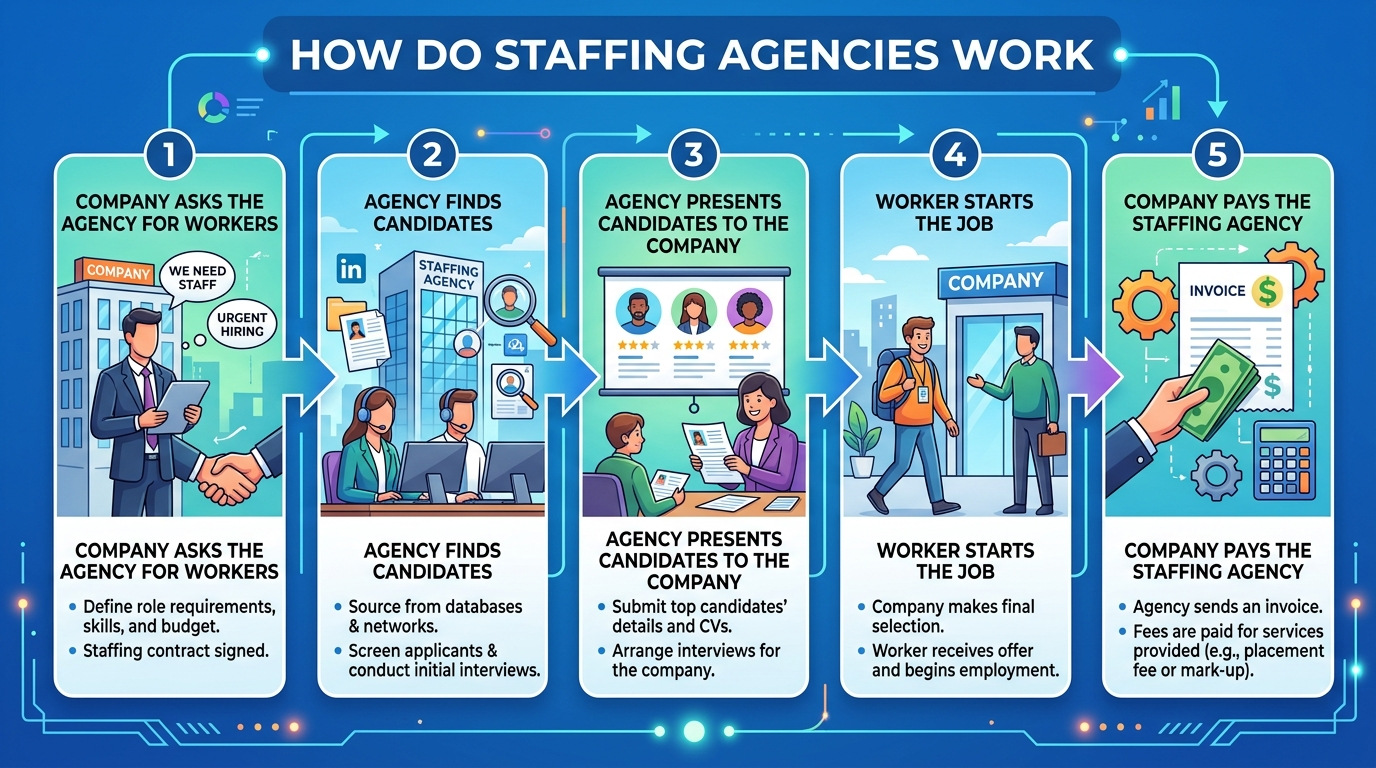
The staffing agency then searches for workers through:
They review resumes, screen candidates, and sometimes conduct initial interviews.
When the agency finds a good match, they send the candidate’s profile to the company.
Depending on the arrangement:
Once the company approves the candidate, the worker begins the assignment.
For temporary or contract roles, the worker is typically employed by the staffing agency rather than the company where they perform the work. The agency handles onboarding tasks such as employment paperwork, tax forms, and scheduling.
The worker performs their duties at the client company’s location, but the staffing agency remains responsible for administrative tasks like payroll and HR support.
Instead of paying the worker directly, the client company pays the staffing agency.
The agency charges either:
For example, if a worker earns $20 per hour, the company might pay the staffing agency $28 per hour. The difference covers recruiting costs, payroll processing, insurance, and the agency’s service fee.
Short-term assignments to fill immediate or seasonal needs.
Workers start on a temporary contract with the possibility of becoming full-time employees if the company decides to hire them permanently.
The agency sources and screens candidates, but the worker is hired directly by the company. The employer pays the agency a one-time placement fee.
Professionals are hired for a defined project or time period, often in specialized fields such as IT, engineering, or finance.
Applying through a staffing agency is slightly different from applying directly to a company, but the process is straightforward.
Here’s what typically happens:
It’s important to actively apply and track your applications rather than rely on being “on a list.” Agencies match candidates to openings—they won’t call you without action on your part. Staying in contact with recruiters and keeping your resume up to date increases your chances of getting placed quickly.
Legitimate staffing agencies do not charge job seekers for job placement. Instead, employers pay the agency for recruiting and workforce management services.
If you are applying for a temporary role, the agency typically pays your wages and may also provide benefits depending on the assignment. The client company pays the agency an hourly rate or service fee.
Job seekers should be cautious of agencies that request upfront payment for job placement, as this is uncommon in the staffing industry.
You apply to the staffing agency by submitting your resume or applying to a job posting. A recruiter reviews your experience and matches you with open roles. If an employer is interested, you may complete an interview. For temporary jobs, the staffing agency usually hires you and handles payroll while you work at the client company.
It can be worth it if you want faster access to jobs or flexible work. Staffing agencies can connect you with employers that are actively hiring and may offer opportunities that aren’t publicly advertised. Temporary roles can also lead to permanent positions through temp-to-hire arrangements.