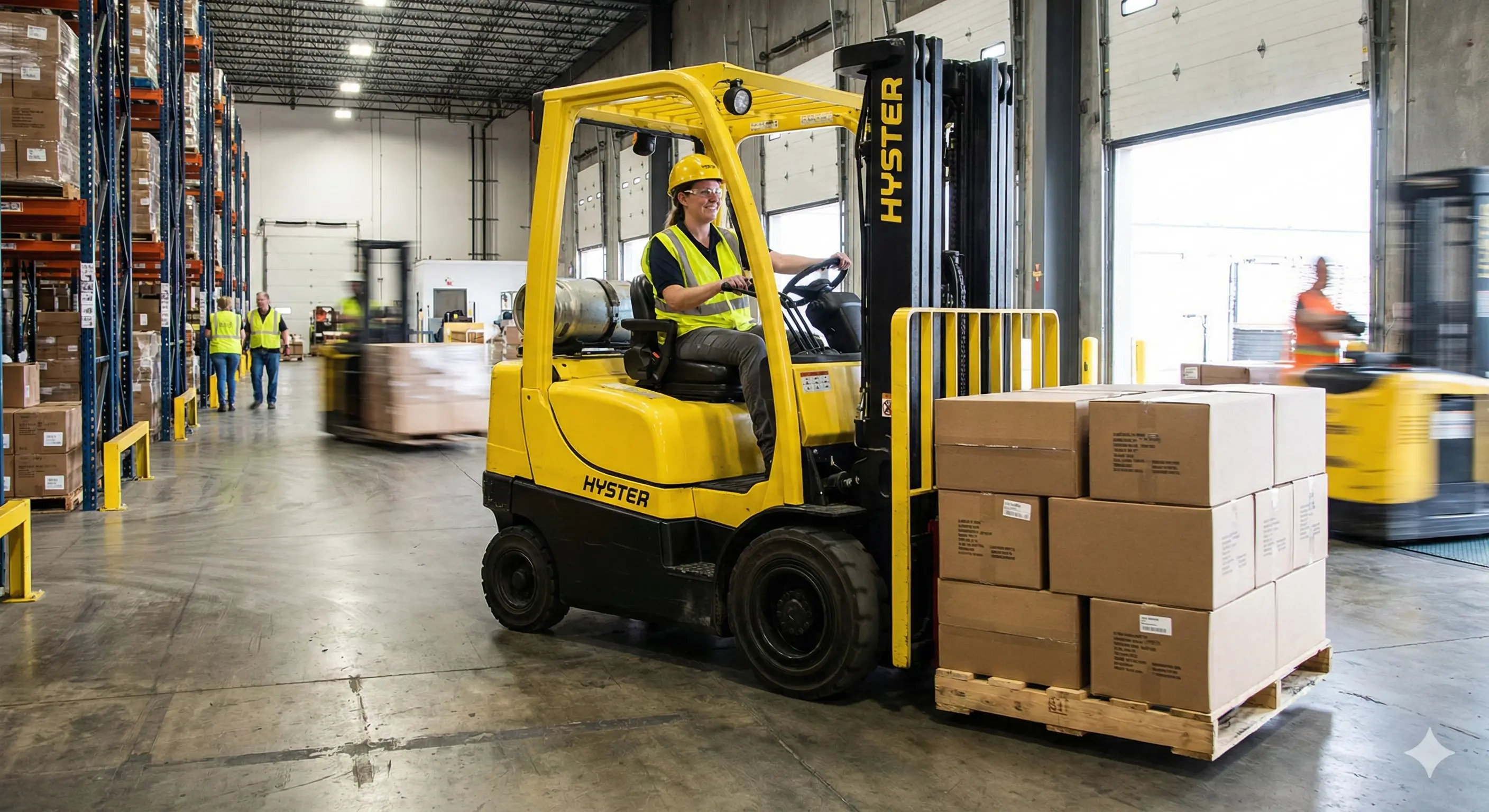
Forklift Operator Interview Questions (With Example Answers)Forklift Operator Interview Questions (With Example Answers)

Learn how we can meet your staffing needs

Forklift operators keep warehouses and worksites moving by handling materials safely, accurately, and on time. Interviews can be tricky because they test real-world safety judgment, equipment know-how, and reliability under pressure. This guide gives employers and candidates practical forklift operator interview questions, sample answers, and clear signals of strong responses.

Top Interview Questions

  1. Which forklift types have you operated, and for how long with each?
  2. Walk me through your pre-shift inspection—what do you check and why?
  3. How do you calculate safe load limits and prevent overloading?
  4. Describe what you do if the forklift malfunctions while in use.
  5. How do you maneuver safely in tight aisles, on ramps, or on uneven ground?
  6. What safety standards or OSHA requirements guide your daily work?
  7. What is an RF scanner, and how do you use it with a WMS?
  8. Scenario: A load becomes unstable mid-transport—what steps do you take?
  9. How do you communicate while operating—signals, radios, or spotters?
  10. When the shift gets hectic, how do you prioritize tasks without sacrificing safety?

Technical & Safety Questions

Which forklift types have you operated, and for how long with each?

Sample Answer: I’ve operated sit-down counterbalance trucks (electric and LPG) for four years and reach trucks for two years in narrow aisles. I also have limited exposure to pallet jacks and order pickers and am open to training on any models you use.

What a Strong Answer Includes

  • Specific models and power types with honest tenure and proficiency
  • Examples of environments (e.g., cold storage, tight aisles) tied to equipment
  • Willingness to learn new trucks or attachments safely

Walk me through your pre-shift inspection—what do you check and why?

Sample Answer: I start with visual checks (tires, forks, chains, mast, leaks), then test safety devices, brakes, steering, hydraulics, horn, and lights. I document findings, tag out anything unsafe, and notify maintenance before operating.

What a Strong Answer Includes

  • Systematic sequence that covers critical safety components
  • Emphasis on documentation and removing unsafe equipment from service
  • Understanding of why each check prevents incidents and downtime

How do you calculate safe load limits and prevent overloading?

Sample Answer: I verify the data plate capacity at the stated load center, confirm weight and load dimensions, and keep the center of gravity inside the stability triangle. If in doubt, I split the load, adjust mast/tilt, or choose equipment with higher capacity.

What a Strong Answer Includes

  • Reference to data plate, load center, and weight distribution
  • Steps to maintain stability (low travel height, tilt back as appropriate)
  • Decision points for using different equipment or repacking the load

Describe what you do if the forklift malfunctions while in use.

Sample Answer: I stop, lower the load, set the brake, neutralize, and shut down in a safe area. I tag out the truck, report the issue, and follow site procedures, including lockout/tagout if required.

What a Strong Answer Includes

  • Immediate actions to control the hazard and protect people and product
  • Clear reporting and tag-out steps aligned with company procedures
  • Awareness of lockout/tagout and when it applies

How do you maneuver safely in tight aisles, on ramps, or on uneven ground?

Sample Answer: I reduce speed, keep forks low, use the horn and mirrors at blind spots, and request a spotter when needed. On ramps, I travel with the load uphill and avoid turning on inclines or rough areas.

What a Strong Answer Includes

  • Speed control, awareness, and proper use of spotters and signals
  • Ramp rules (load uphill) and avoiding turns on slopes
  • Adjustments for weather, lighting, and surface conditions

What safety standards or OSHA requirements guide your daily work?

Sample Answer: I follow OSHA 1910.178 and company SOPs, including seatbelts, speed limits, and pedestrian right-of-way. My certification is current, with recertification every three years and refreshers after incidents or unsafe operation.

What a Strong Answer Includes

  • Reference to OSHA rules and site-specific policies
  • Evidence of current certification and refreshers when triggered
  • Practical examples of applying the rules on the floor

How do you secure loads and minimize product damage during transport?

Sample Answer: I check pallet integrity, align forks evenly, and stabilize with tilt and low travel height. If needed, I re-stack, wrap, or strap before moving to reduce shifting and product damage.

What a Strong Answer Includes

  • Attention to pallet condition and even weight distribution
  • Use of restraints and careful stacking to prevent movement
  • Low, controlled travel to keep the center of gravity stable

Explain differences between counterbalance and reach trucks; when use each?

Sample Answer: Counterbalance trucks are versatile for docks, yards, and general handling; reach trucks are designed for narrow aisles and higher racking with pantograph reach. I choose based on aisle width, lift height, and load profile.

What a Strong Answer Includes

  • Clear contrasts in design, maneuverability, and typical use cases
  • Selection criteria tied to facility layout and racking heights
  • Awareness of stability considerations at height

What attachments have you used, and when are they appropriate?

Sample Answer: I’ve used side shifters for precise placement, clamps for white goods and paper, and fork positioners for varying pallet widths. I confirm the attachment’s de-rated capacity on the data plate before use.

What a Strong Answer Includes

  • Attachment names matched to specific products or tasks
  • Capacity de-rating awareness when attachments are installed
  • Safety checks and technique adjustments for each attachment

Behavioral & Situational Questions

Scenario: A load becomes unstable mid-transport—what steps do you take?

Sample Answer: I stop smoothly, lower the load to a safe height or place it down in a clear area, and re-stack or secure it before continuing. I ask for assistance or a spotter if needed and never try to catch a falling load.

What a Strong Answer Includes

  • Calm hazard control and immediate stabilization
  • Use of assistance and proper securing methods
  • Explicit avoidance of risky actions like catching loads

You’re on a tight deadline and your manager adds an urgent task—what do you do?

Sample Answer: I clarify priorities and expected deadlines, sequence tasks by proximity and equipment needed, and keep speeds safe. I communicate any trade-offs early to avoid surprises.

What a Strong Answer Includes

  • Proactive clarification and realistic planning under pressure
  • Efficiency tactics that don’t compromise safety
  • Transparent communication about timelines and constraints

Describe a time you operated incorrectly or made a mistake—what changed afterward?

Sample Answer: I once rushed a turn in a congested aisle and had a near miss; I reported it, reviewed the SOP, and adjusted my route and speed. Since then, I build in buffer time and use spotters more consistently.

What a Strong Answer Includes

  • Accountability without excuses and a clear lesson learned
  • Concrete changes to behavior or process
  • Evidence of sustained improvement over time

You observe a coworker acting unsafely or not using PPE—what do you do?

Sample Answer: I pause operations if there’s immediate risk, remind them respectfully about the requirement, and escalate to a supervisor if it continues. I document serious concerns per policy.

What a Strong Answer Includes

  • Safety-first intervention that’s respectful and policy-aligned
  • Escalation steps when behavior doesn’t change
  • Willingness to document significant incidents

Communication, Teamwork & Time Management Questions

How do you communicate while operating—signals, radios, or spotters?

Sample Answer: I use standard hand signals with spotters, maintain eye contact, and confirm directions over radio before moving. I yield to pedestrians and announce at intersections and blind spots.

What a Strong Answer Includes

  • Consistent use of standard signals and radios
  • Pedestrian awareness and right-of-way habits
  • Verification techniques to prevent misunderstandings

When the shift gets hectic, how do you prioritize tasks without sacrificing safety?

Sample Answer: I batch work by area, group similar picks, and plan routes to reduce travel. I update the lead on ETAs and refuse shortcuts that undermine safety, such as lifting passengers or speeding.

What a Strong Answer Includes

  • Route planning and batching to increase efficiency
  • Active coordination with supervisors on priorities
  • Non-negotiable safety boundaries under pressure

How do you handle conflicts with coworkers?

Sample Answer: I address issues directly and privately, focus on the task and safety facts, and involve a lead only if we can’t resolve it. My goal is a clear plan everyone can follow safely.

What a Strong Answer Includes

  • Professional, calm communication focused on work and safety
  • Efforts to resolve at the lowest appropriate level
  • Openness to mediation when needed

Culture & Motivation Questions

What work environment and culture do you thrive in?

Sample Answer: I do best in teams that value clear communication, clean work areas, and consistent safety standards. Predictable processes help me stay efficient and accurate.

What a Strong Answer Includes

  • Specific cultural preferences tied to performance and safety
  • Alignment with the company’s pace and standards
  • Openness to feedback and continuous improvement

Why this company and role—why should we hire you?

Sample Answer: Your operation uses the equipment I know best, and your safety record stands out. I bring multi-truck experience, low damage rates, and strong attendance to keep throughput reliable.

What a Strong Answer Includes

  • Evidence of research about the company and equipment
  • Clear value proposition (quality, speed, safety, reliability)
  • Metrics or examples that show impact

Inventory, RF Scanners & Documentation Questions

What is an RF scanner, and how do you use it with a WMS?

Sample Answer: I scan at every movement—pick, putaway, transfer, and cycle count—to confirm item, lot, and bin. Following the WMS prompts reduces errors and keeps inventory accurate in real time.

What a Strong Answer Includes

  • Link between disciplined scanning and inventory accuracy
  • Understanding of common workflows (pick/putaway/count)
  • Examples of error reduction or faster reconciliation

How do you keep accurate records for inspections, maintenance, and inventory?

Sample Answer: I complete inspection checklists at the start of shift, report defects immediately, and log work in the WMS or maintenance system. I double-check locations and quantities before confirming transactions.

What a Strong Answer Includes

  • Consistent use of checklists and digital systems
  • Prompt reporting and documentation of defects
  • Verification steps to prevent data errors

Questions Candidates Should Ask Employers

  • How does your company prioritize forklift safety?
  • Which equipment models and attachments are used most here?
  • What skills are most critical for success in this role?
  • How are shifts structured, and what are typical workflows?
  • What training or refresher programs are offered, and how often?

Preparation Tips

For employers: Map site-specific risks (ramps, tight aisles, pedestrian zones) and equipment before interviewing. Use consistent questions across candidates and probe for concrete examples showing safety, accuracy, and communication. Consider a brief practical or ride-along assessment when feasible.

For candidates: Bring proof of certification and be ready to describe your inspection process, load handling, and incident responses. Review OSHA basics, especially capacity/data plates, stability, and pedestrian rules. Prepare concise stories about pressure, mistakes learned from, and process improvements.

FAQs

How often must forklift operators renew certification?

Every three years, with refresher training after incidents, unsafe operation, or changes in equipment or workplace conditions.

What are common pre-shift inspection items?

Brakes, steering, tires, forks, mast/chain, hydraulics, horn, lights, seatbelt, and any leaks—plus documentation and removing unsafe trucks from service.

Why do interviewers ask about RF scanners and WMS?

Because accurate scanning and system use drive inventory accuracy and productivity, reducing errors that lead to damage or rework.

Conclusion

Great forklift operators blend safety discipline, technical skill, and teamwork to keep products and people safe. Use these questions, sample answers, and strong-answer cues to run focused interviews and prepare effectively. With the right preparation, both employers and candidates can find the best mutual fit.

To explore a new path forward in campus staffing.